English
 Español
 italiano
Content
- 1 What Is Gabardine Fabric? A Weave First, a Fiber Second
- 2 Inside the Weave: Why the Diagonal Line Does the Work
- 3 Cotton, Wool, Polyester and Blends: Choosing the Fiber Behind the Weave
- 4 Weight Bands: The GSM Number That Decides the End Use
- 5 Where Gabardine Earns Its Place: Garments, Uniforms and Workwear
- 6 Before You Place the Order: A Gabardine Buying Checklist
- 7 Sewing and Care Notes That Prevent Returns
- 8 Sourcing Gabardine From a Manufacturer: What to Look For
- 9 FAQ: Gabardine Fabric Questions Buyers Ask Most
- 9.1 Is gabardine natural or synthetic?
- 9.2 Is gabardine waterproof?
- 9.3 What is gabardine fabric used for?
- 9.4 Is gabardine good for summer?
- 9.5 Does gabardine have a nap?
- 9.6 What is the difference between twill and gabardine?
- 9.7 Does cotton gabardine shrink?
- 9.8 Can gabardine be washed at home?
- 9.9 How do I compare gabardine quotations fairly?
- 9.10 What should a first sample tell me?
Two rolls arrive on the cutting table with the same word on the label: gabardine. One behaves like a trench coat shell, firm across the warp and glass-smooth under the finger. The other behaves like trouser cloth, softer, with more give on the bias. Both are correctly named, because gabardine describes how a fabric is built rather than what it is made from, and that single distinction answers most of the questions buyers and garment technicians raise about it.
Ask what gabardine fabric is in a mill office and the answer starts with the weave: a dense, steep twill with the warp on the face and the weft tucked beneath. Ask the same question in a design studio and the answer starts with the fiber: cotton for trench coats, worsted wool for tailoring, polyester or a polyester-viscose blend for uniforms and volume trouser programmes. Both answers are right, and they describe the same cloth from opposite ends of the supply chain.
This guide works from the weave outward. It covers how the structure is built, how fiber choice changes the care label, which weight bands suit which garments, and the checks that separate a smooth bulk order from a container of complaints. If you are sourcing rather than sewing, the buying checklist and the FAQ section near the end are written for you.
What Is Gabardine Fabric? A Weave First, a Fiber Second
Gabardine is a tightly woven twill fabric with a steep diagonal rib running across the face. The warp yarns sit on top of the weft for most of the repeat, which is why the cloth is described as warp-faced: the fine, densely packed warp does the visible work, while the weft hides underneath and gives the back its softer, slightly duller hand.
Three features separate gabardine from a generic twill, and they are worth knowing before you compare quotations from two suppliers:
- A steep twill angle. Standard twill lines run at roughly 45 degrees. Gabardine lines run visibly steeper, closer to 60 to 70 degrees, which is what gives the fabric its narrow, almost vertical rib rather than a broad diagonal.
- A high warp sett. Ends per inch are noticeably higher than in a plain weave or open twill of similar weight. The warp covers the weft almost completely, and that density is where the wind resistance and the light rain-shedding behaviour come from.
- A fine warp against a coarser weft. The mismatch is deliberate. A fine, strong warp produces the clean rib and the smooth face; a slightly heavier weft fills the structure and adds body without making the cloth harsh.
The name entered commercial textiles in 1879, when a British clothier patented a worsted twill treated with lanolin and sold it as weather-resistant outerwear cloth. The word itself is usually traced back to the Spanish "gabardina", a term for a raincoat or coarse cloak, which explains why the fabric has been associated with protection from weather for well over a century. What began as a single worsted product is now a family: cotton gabardine for coats and chinos, wool gabardine for tailoring, polyester and TR gabardine for uniforms, workwear and high-volume trouser programmes.
Because the label describes a structure, two rolls can share the name and behave nothing alike. A 150 gsm cotton gabardine shirting and a 300 gsm wool gabardine coating have the same twill logic and completely different commercial lives. That is why a purchase order that says only "gabardine" is not a specification - it is an invitation to a dispute.
| Fabric | Weave structure | Face and back | Typical garment weight | Common uses |
|---|---|---|---|---|
| Gabardine | Steep warp-faced twill, 2/1 or 3/1 | Fine, clear diagonal rib on the face; softer back | 150-320 gsm | Trench coats, suits, trousers, uniforms, skirts |
| Denim | 3/1 twill, indigo-dyed warp | Visible diagonal, strong colour contrast at the cut edge | 300-450 gsm | Jeans, jackets, heavy workwear |
| Serge | Balanced 2/2 twill | Clear diagonal, both sides look similar | 200-350 gsm | Suits, linings, uniform cloth |
| Drill | 2/1 or 3/1 twill, medium density | Pronounced diagonal, firmer and flatter than gabardine | 200-300 gsm | Workwear, chinos, aprons, bags |
| Cavalry twill | Double twill with a raised cord | Rounded double cord, very firm | 300-450 gsm | Riding breeches, heavy trousers, heritage outerwear |
| Poplin | Plain weave, fine warp | Smooth with no diagonal | 100-180 gsm | Shirts, dresses, light linings |
Inside the Weave: Why the Diagonal Line Does the Work
The diagonal is not decoration. It is the visible result of how the yarns are lifted and packed, and every performance claim attached to gabardine traces back to it.
The angle of the twill
A standard 2/2 twill advances one warp end per pick, producing a line near 45 degrees. Gabardine is built so the line advances more slowly across the cloth, which steepens the angle and narrows the rib. The practical effect is a surface made of many short floats rather than fewer long ones, so abrasion is spread across the cloth instead of concentrated on a single exposed yarn. In wear tests on uniforms and trousers, that shows up as slower surface polish and less fibre breakdown at the seat and thigh.
Warp density and the buried weft
When the warp sett is pushed high, the weft has almost nowhere to show. The face becomes a nearly continuous sheet of warp yarn, and that has consequences a buyer can measure: air permeability drops compared with a poplin of the same weight, surface strength rises, and a light shower tends to bead rather than soak straight through. The trade-offs are real too. Very dense gabardine needs finer needles and more careful seam planning, and dark shades can show rub marks or press marks if the finishing route is pushed too hard.
Finishing: matte face, soft back
Most gabardine leaves the mill without a nap, but many qualities are brushed or peach-finished on the back for comfort against the skin. Calendering sharpens the face and lifts the subtle lustre the cloth is known for; an enzyme wash or a silicone softener pulls the hand back towards casual. Water-repellent finishes are common on outerwear weights, and the shift from long-chain to C0 fluorocarbon-free chemistry has changed how those finishes age after ten or twenty home washes - a point worth testing rather than assuming.
Yarn quality decides the rib
A crisp, continuous diagonal depends on uniform warp yarn. Combed or compact-spun cotton and compact siro-spun yarns reduce hairiness, which keeps the rib sharp instead of blurring it under fuzz. Mills that spin their own warp yarn have an advantage here, because they can hold count and twist consistency across a long production run instead of buying whatever is on the spot market that month.
Cotton, Wool, Polyester and Blends: Choosing the Fiber Behind the Weave
The weave sets the behaviour of the cloth. The fiber sets the price, the comfort profile and the care label, and that is where most sourcing decisions are actually made.
Cotton gabardine
This is the version most people meet first, usually on a trench coat or a pair of chinos. Cotton gabardine takes a mercerised finish well, holds a crease, and can be washed at home if the cloth has been pre-shrunk. Untreated cotton gabardine is the classic shrinkage risk: two to five percent on the warp after the first hot wash is not unusual, which is enough to turn a well-fitting trouser into a short one. Ask for the shrinkage figure from the actual wash method your care label will specify, not from a generic test.
Wool gabardine
Worsted wool gabardine is the tailoring classic. It drapes with weight, presses to a sharp crease, resists wrinkling in wear, and recovers overnight on a hanger. The density that makes it weather-resistant also makes it a dry-clean fabric in most qualities. Where a buyer wants the wool look with easier care, wool-rich blends with polyester are common, and the blend ratio drives both the hand and the price far more than the weave does.
Polyester and TR gabardine
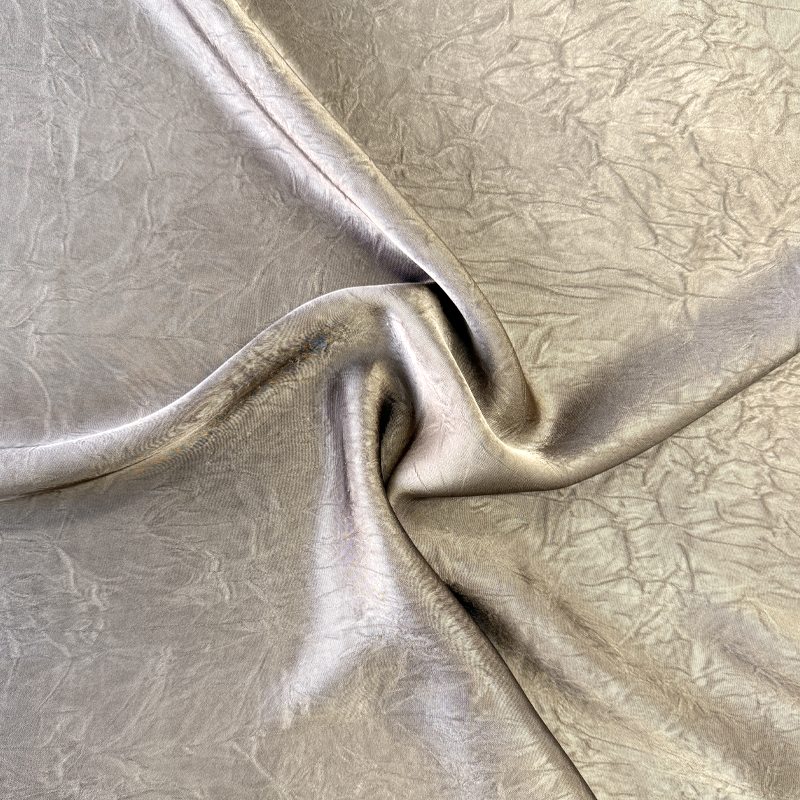
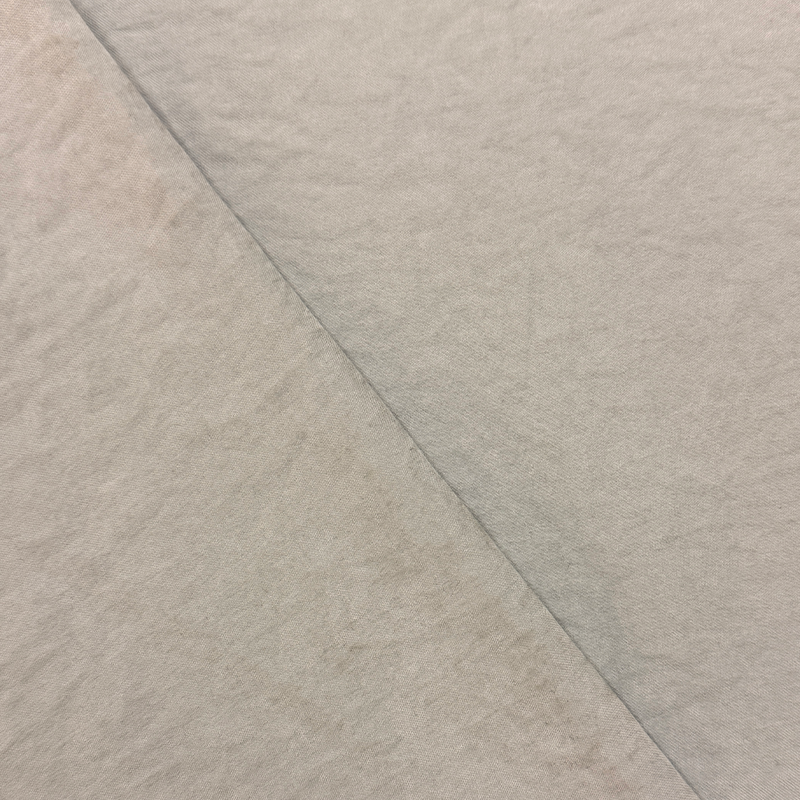
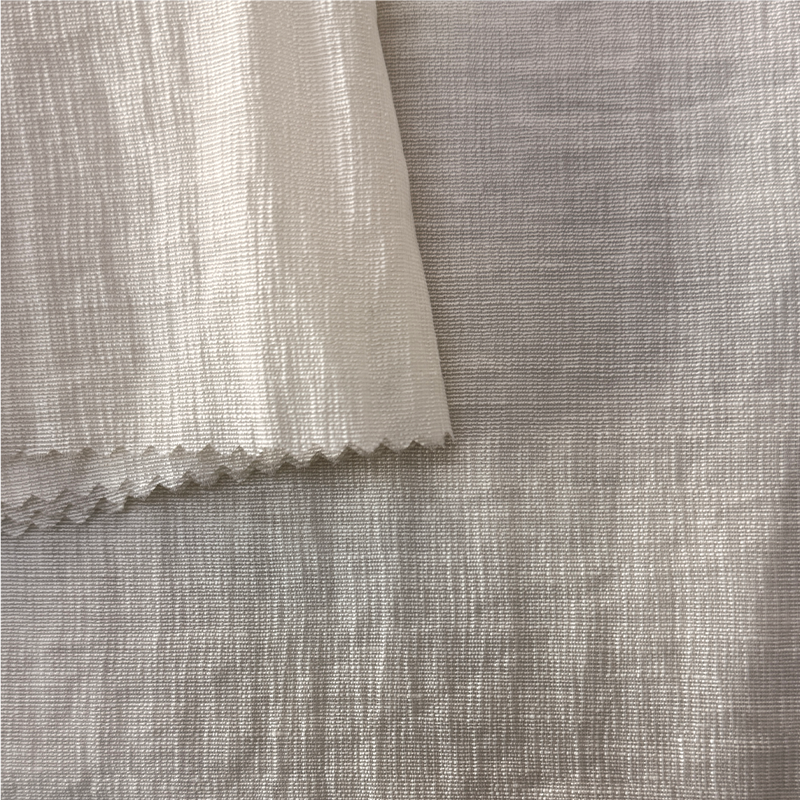
Polyester gabardine and TR gabardine (polyester with viscose) dominate uniform, workwear and volume trouser programmes because they hold shape, resist fading, dry quickly and cost less per metre than wool. Modern filament and spun polyester can be engineered to a matte, cotton-like face rather than the shiny surface the category was known for twenty years ago. Our TR fabric series includes stretch twill, cloud-soft and imitation denim constructions built on exactly this logic, aimed at buyers who want gabardine performance without the wool price or the cotton shrinkage.
 TR Stretch Twill for Trousers, Skirts and SuitsA 75% T/18% R/7% SP stretch twill for wide-leg trousers, skirts and suits, offering natural drape, elasticity and easy-care wrinkle resistance.View Product →
Stretch gabardine
Adding two to four percent elastane transforms the cloth for trousers and skirts, but it introduces a behaviour worth flagging early: twill plus stretch can produce torque, so the leg of a trouser may spiral slightly after washing. Buyers usually control this by specifying a skew limit and by asking the mill to relax the cloth before cutting. Stretch gabardine also needs a heat-setting route that will not yellow the face or kill the recovery.
Recycled, organic and finished variants
Recycled polyester gabardine, organic cotton gabardine and low-impact finished qualities now sit in mainstream uniform tenders rather than niche collections. The structural performance is broadly the same; the questions move to traceability, certificate coverage and whether the recycled content is pre- or post-consumer. Finishes are the other differentiator - water repellency, anti-pilling, peach touch, moisture management - and each one should be specified with a test method and a wash durability target, otherwise two mills will deliver two different products under one name.
Weight Bands: The GSM Number That Decides the End Use
Weight is the fastest filter when you are shortlisting gabardine qualities, because a cloth outside its natural band will fight the garment pattern no matter how good the fiber is. The ranges below reflect what mills typically quote for garment gabardine, and they overlap deliberately at the boundaries.
Typical gabardine weights by end use, grams per square metre (bar length shows the midpoint)
The chart is a planning tool, not a rule. A stretch trouser cloth below 200 gsm can work in a summer chino if the twist is high enough and the finishing tight, while a 260 gsm cotton gabardine in a structured skirt will feel heavy next to a 210 gsm alternative from the same collection. What matters is that the weight, the fiber and the finishing route are chosen together rather than in sequence.
In practice, most sourcing enquiries we handle sit in the 200 to 260 gsm window, because that band covers trousers, uniforms, skirts and light jackets with one cloth family. From there, buyers usually ask for two or three weights of the same construction so the range holds together visually while serving different garments. Keeping the construction stable and moving only the weight is far easier to control than switching weave and weight at the same time.
Weight also drives yield calculations. A 240 gsm cloth at 150 cm usable width gives a different marker consumption from a 280 gsm cloth of the same width, and that difference usually outweighs a small price gap per metre. When comparing quotations, convert to cost per garment rather than cost per metre, and the cheaper roll frequently stops being cheaper.
Where Gabardine Earns Its Place: Garments, Uniforms and Workwear
Gabardine shows up wherever a garment has to look orderly at eight in the morning and still look orderly at six in the evening. The applications below are the ones that come up most often in sampling and bulk enquiries.
Outerwear and trench coats
Trench coats are the reference garment. The tight warp-faced face sheds a shower, the cloth holds a clean edge along the placket and storm flap, and it presses flat without shining. Cotton gabardine in the 240 to 320 gsm range is the standard answer, with a water-repellent finish and a pre-shrunk preparation so the coat does not shorten after its first clean.
Tailoring and suits
Wool gabardine makes suits that resist creasing in a car or a plane seat, which is why it holds a place in travel tailoring and uniform suiting. The steep twill gives a dry, matte surface that photographs well and does not pick up light the way a plain-weave worsted can.
Trousers, skirts and uniforms
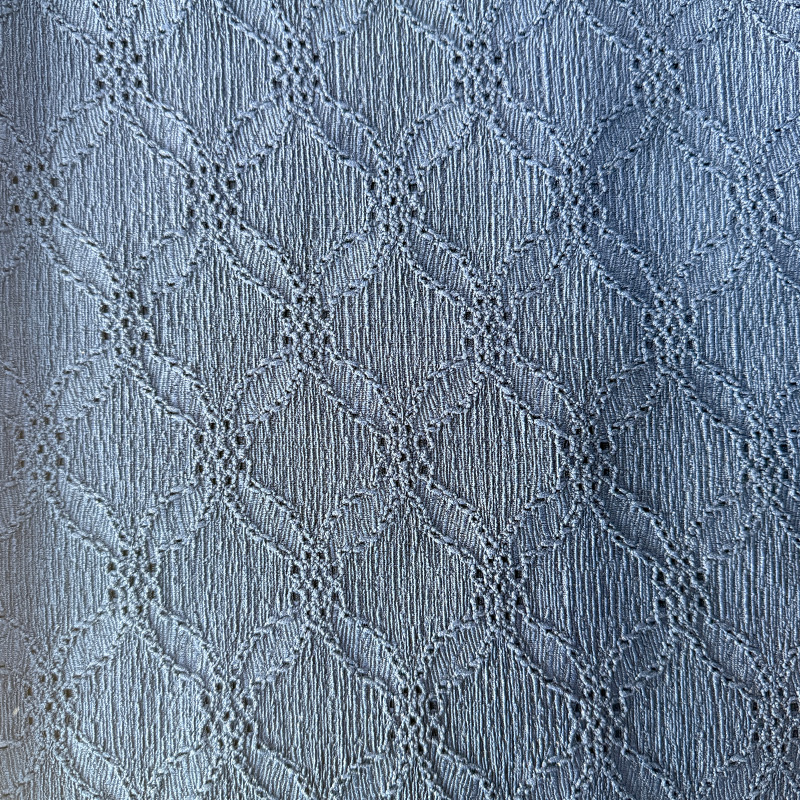
This is the volume end of the market. Gabardine trousers keep a centre crease, hide seat wear better than a plain weave, and can be built with two or three percent stretch for comfort. Skirts benefit from the same body and drape without the stiffness of a heavier drill. For buyers working in denim-adjacent collections, a slub-textured imitation denim in a gabardine construction gives the look without the indigo crocking risk.
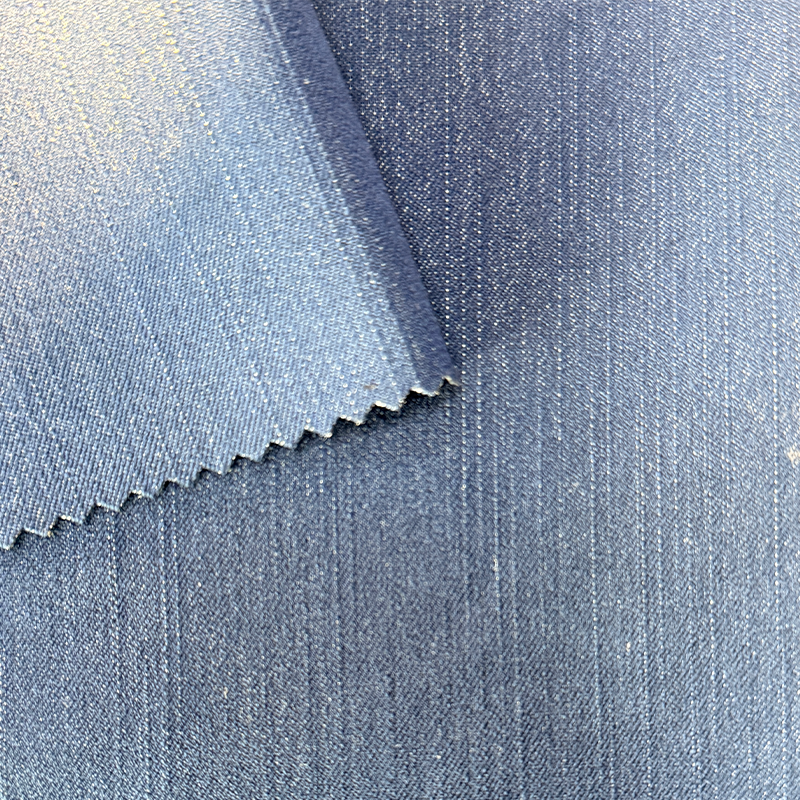 TR Imitation Denim Slub with Stretch for Casual WearA 360 GSM slub-textured TR twill with 6% spandex, giving denim-like structure, stretch and easier care for casual garments.View Product →
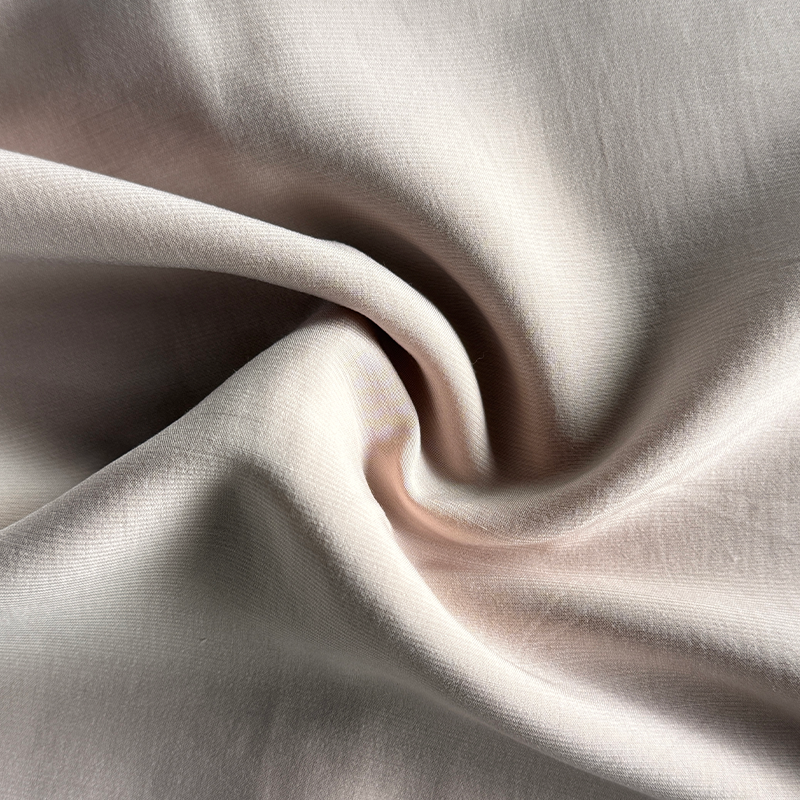
Skirt programmes are a good example of how small construction changes matter. A cloth with a soft, smooth hand and enough weight to hang straight will cut and sew very differently from a crisp uniform twill of the same weight, even when both carry the same weave name.
 Polyester-Nylon Skirt Fabric with Drape and SupportA 90% polyester/10% nylon, 160 GSM woven fabric for elegant skirts and dresses, combining silk-like softness, drape and shape support.View Product →
Workwear, bags and accessories
Drill and gabardine overlap heavily in workwear. Where the brief calls for a cleaner face, better wind resistance or a more tailored look, gabardine usually wins; where abrasion at the knee matters more than appearance, a heavier drill often holds up longer. Caps, aprons, tool bags and protective covers use the same tight twill for the same reason: a dense face resists snagging.
Before You Place the Order: A Gabardine Buying Checklist
Most gabardine disputes are not about quality in the abstract. They are about two parties holding different definitions of the same word. The checklist below closes that gap before the deposit is paid.
- Write the weave into the spec. State the twill type, the nominal sett and the yarn counts for warp and weft, not only the fiber content.
- Fix the weight with a tolerance. Nominal gsm plus or minus five percent is a common commercial window; anything tighter needs a conversation about cost.
- Agree the shrinkage method. Home wash, industrial wash and dry clean give three different answers. Specify the method your care label will carry.
- Set a skew limit. Twill cloth can torque, and stretch twill more so. A measurable limit protects both sides.
- Confirm colour fastness grades. Light, wash, rubbing and perspiration are the four that generate returns most often in dark shades.
- Test the finish, not just the fabric. Water repellency and softness both fade with washing; ask for performance after five or ten cycles.
- Run a sew-off. Needle size, stitch density and seam type all interact with a dense twill. A two-metre sew-off catches puckering before bulk.
- Lock lot consistency. Ask how the mill controls shade and hand between dye lots, and what happens if a repeat order arrives six months later.
| Parameter | What to state | Common commercial window |
|---|---|---|
| Fiber content | Blend ratio by percentage, including elastane | Plus or minus 2 percentage points |
| Weight | Nominal gsm and test method | Plus or minus 5 percent |
| Width | Usable width after finishing, not greige width | Minus 2 cm, no plus limit |
| Shrinkage | Warp and weft after the declared wash method | Within 3 percent warp, 2 percent weft |
| Skew or spirality | Percentage displacement after wash | Within 5 percent |
| Colour fastness | Light, wash, rub, perspiration | Grade 4 minimum on the grey scale |
| Pilling | Random tumble method | Grade 4 after the agreed cycles |
| Water repellency | Spray rating, new and after washes | Rating 4 new, 3 after five washes |
Sewing and Care Notes That Prevent Returns
Dense twill behaves differently under the needle from a plain weave, and small adjustments at the sampling stage save a great deal of rework later.
- Use a finer needle than you would for a plain weave of the same weight, and replace it more often; a dense sett dulls points quickly and dull points cause skipped stitches.
- Reduce presser foot pressure slightly and check for puckering along long seams before locking the stitch length.
- Cut all pattern pieces in the same direction along the warp. Gabardine has no nap, but the twill direction still reads differently under light, and mixed cutting shows as shade bands on a finished trouser leg.
- Press on the back or through a cloth. Direct high heat on a polyester face can create a permanent shine that no amount of steaming will lift.
- For cotton and polyester gabardine, a warm machine wash and line dry keeps the face crisp; for wool gabardine, brush and air between wears and dry clean sparingly.
- Warn the end customer about fabric softener. It coats the face of a water-repellent finish and quietly reduces performance over time.
These points sound minor until they appear as a returns line in a retail report. Most of them cost nothing to fix at the sampling stage and a great deal to fix after 20,000 pieces have shipped.
Sourcing Gabardine From a Manufacturer: What to Look For
Gabardine is not difficult to weave, which is exactly why the market is full of qualities that share a name and share very little else. The difference between a reliable supplier and a risky one usually shows up in three places: yarn control, finishing consistency and how clearly they answer technical questions before the order.
Shaoxing Echoes Textile Co., Ltd. sits at the mill end of that conversation. The company has more than twenty years in textile production and export, and operates two dedicated bases: an 80-mu greige weaving mill and an 80-mu modern cotton yarn mill. Daily weaving capacity runs at around 200,000 metres. Because the yarn mill feeds the weaving mill, warp count, twist and hairiness can be held steady across a long run, which is precisely what keeps the diagonal rib of a gabardine sharp from the first roll to the last.
The product range covers woven cotton and polyester constructions, blended qualities, jacquards, lurex and stretch articles, plus recycled, organic and ECO lines for buyers with sustainability requirements written into the tender. Custom development is part of the service, so a buyer can send a target weight, hand, finish and test list and have a counter-sample built around it rather than choosing from a fixed catalogue and compromising on three parameters.
When you send an enquiry, include the garment, the target weight with tolerance, the fiber or blend, the finishing requirement, the colour standard, the test list, the estimated order quantity and the delivery window. Suppliers can quote faster and more accurately when those six items are on the table, and the quotes you receive will actually be comparable.
Talk to the mill directly
FAQ: Gabardine Fabric Questions Buyers Ask Most
Is gabardine natural or synthetic?
Both are possible, because gabardine is a weave rather than a fiber. Cotton and wool gabardine are natural, polyester and polyester-viscose gabardine are synthetic or blended, and many qualities mix the two to balance cost, hand and care. Always read the fiber content, not the weave name.
Is gabardine waterproof?
It is water-repellent by construction, not waterproof. The dense warp-faced twill slows water penetration and makes light rain bead on the surface, but a sustained downpour will eventually get through unless the cloth carries a coating or a laminated membrane. For real rainwear, gabardine is normally the shell, not the whole system.
What is gabardine fabric used for?
Trench coats, suits, trousers, skirts, uniforms, workwear, caps, aprons and bags are the main applications. It is chosen where shape retention, abrasion resistance and a clean surface matter more than softness or drape.
Is gabardine good for summer?
Lightweight cotton gabardine in the 130 to 170 gsm range works well for summer trousers and skirts because the tight weave handles creasing and keeps a neat line in heat. Heavier wool gabardine is a cool-weather cloth. Breathability depends more on fiber, weight and finish than on the twill itself.
Does gabardine have a nap?
Generally no. Gabardine is not a napped fabric, so it does not have the directional pile of velvet or flannel. It does have a twill direction, however, and cutting all pieces the same way prevents the subtle shade differences that appear when some panels catch the light differently.
What is the difference between twill and gabardine?
Gabardine is a specific member of the twill family. All gabardine is twill, but not all twill is gabardine. The defining differences are a steeper diagonal, a higher warp sett and a fine warp paired with a coarser weft.
Does cotton gabardine shrink?
Untreated cotton gabardine can shrink two to five percent on the warp after a hot wash. Most garment qualities are pre-shrunk or sanforised, and the shrinkage figure should always be quoted against the wash method on your care label.
Can gabardine be washed at home?
Cotton and polyester gabardine usually can be, at 30 to 40 degrees, with a low spin and line drying. Wool gabardine is normally dry clean only. Skip fabric softener on any water-repellent quality, because it coats the finish.
How do I compare gabardine quotations fairly?
Convert the price per metre into cost per garment using the real marker consumption for your pattern, then compare on weight, width, shrinkage, fastness and finish durability. A roll that is cheaper per metre but narrower and lighter is frequently the more expensive option.
What should a first sample tell me?
Check the rib clarity against a light, the hand on both face and back, the shrinkage after your declared wash, the skew, and how the cloth behaves at a seam. A sample that answers those five questions will save months of back-and-forth later.